
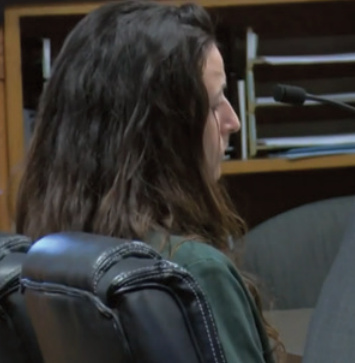
A judge will rule April 10 on whether Joanna Ford can participate in a substance abuse treatment program that would modify her sentence.
“This court is not going to shorten Ms. Ford’s sentence,” Judge Lisa McDougal said in Iowa County Court Tuesday afternoon. “It is simply a matter of the structure of her sentence.”
Ford, 33, of Mineral Point, was sentenced two years ago to 11 years in prison and 12 years extended supervision.
She pled guilty to one count of neglecting a child resulting in the death of four-month-old Wyatt Hamlin and four other counts of neglecting a child.
At the time of sentencing, “everybody in the courtroom thought she wasn’t eligible (for earned release programming), but she is,” said District Attorney Zachary Leigh.
Her crime is not excluded from participation by state statute.
Ford’s attorney Jeremiah Meyer-
O’Day filed a motion asking that she be granted eligibility for either the Wisconsin Substance Abuse Program or the Challenge Incarceration Program.
His motion said Ford has been a “model prisoner in all respects” and has “significant substance abuse issues and that she is both ready and willing to address those issues as well as she can inside the Wisconsin Prison System.”
Many people wearing Wyatt’s Warriors shirts in support of the Hamlins filled one side of the courtroom.
Wyatt’s father, David Hamlin, said the motion is “a loophole to allow her to shave time off her sentence.”
“The sentence of 11 years was not excessive. It was necessary,” said Wyatt’s mother, Kayla Hamlin. “The original sentence reflected the seriousness of what happened and the value of his life. Doing well in confinement does not demonstrate growth.”
The Hamlins said returning to court for the hearing caused them pain, heartbreak and anxiety.
“It forces me to relive the day my son died,” Kayla Hamlin said. “I was forced to grieve my child while waiting for his body to die. The sound of my son’s gasps is the last memory I have of him alive.”
Meyer-O’Day said it was unfortunate Ford’s eligibility wasn’t dealt with during the original sentencing.
“Everybody in that courtroom thought she wasn’t eligible, but she is,” said District Attorney Zachary Leigh. “The facts of the case have not changed, and neither should your sentence,” he told the judge.
“Not a day has gone by that I don’t think of Wyatt,” said Ford, wearing a dark green prison uniform in court. “I am not the same person who was sitting in front of you two years ago,” she told the judge.
She said that she has “completed an intense therapy program” and is becoming a healthier person.
Ford was “deeply broken at the time of the offense,” while acknowledging “a terrible tragedy that no one is trying to minimize,” her lawyer said.
Inmates in earned release programs are transferred to treatment centers within the prison system to complete the required programming and then released to extended supervision.
“At maximum, her 11-year confinement would be down to eight years. It could be as little as two years off confinement,” Meyer- O’Day said. “It is not a reduction in sentence. It does not change the overall sentence. It is simply a change in structure.”