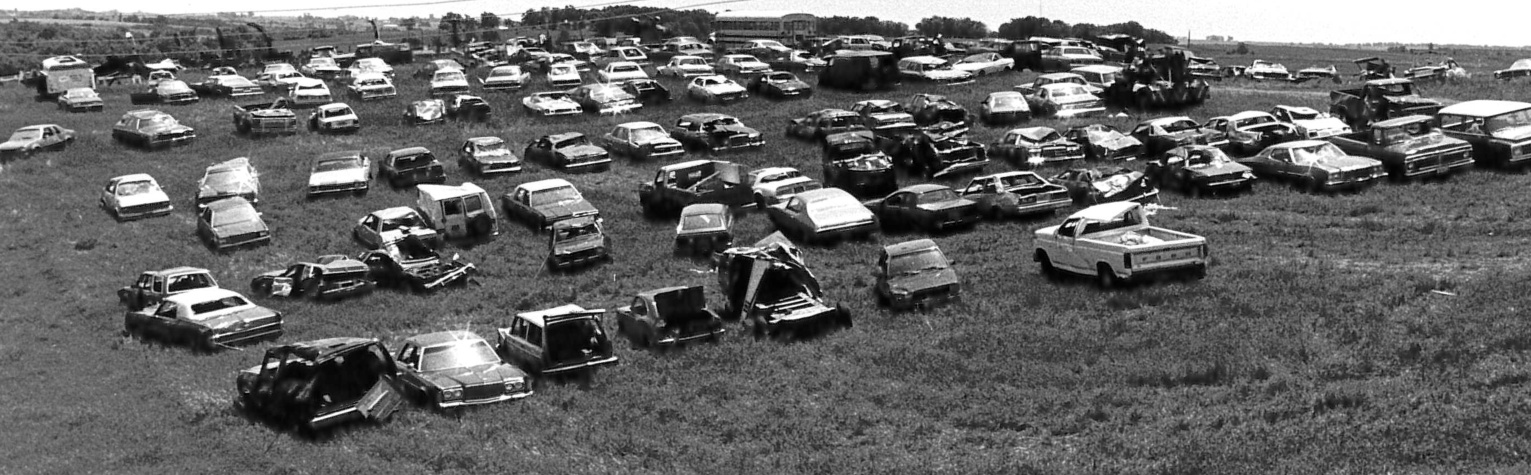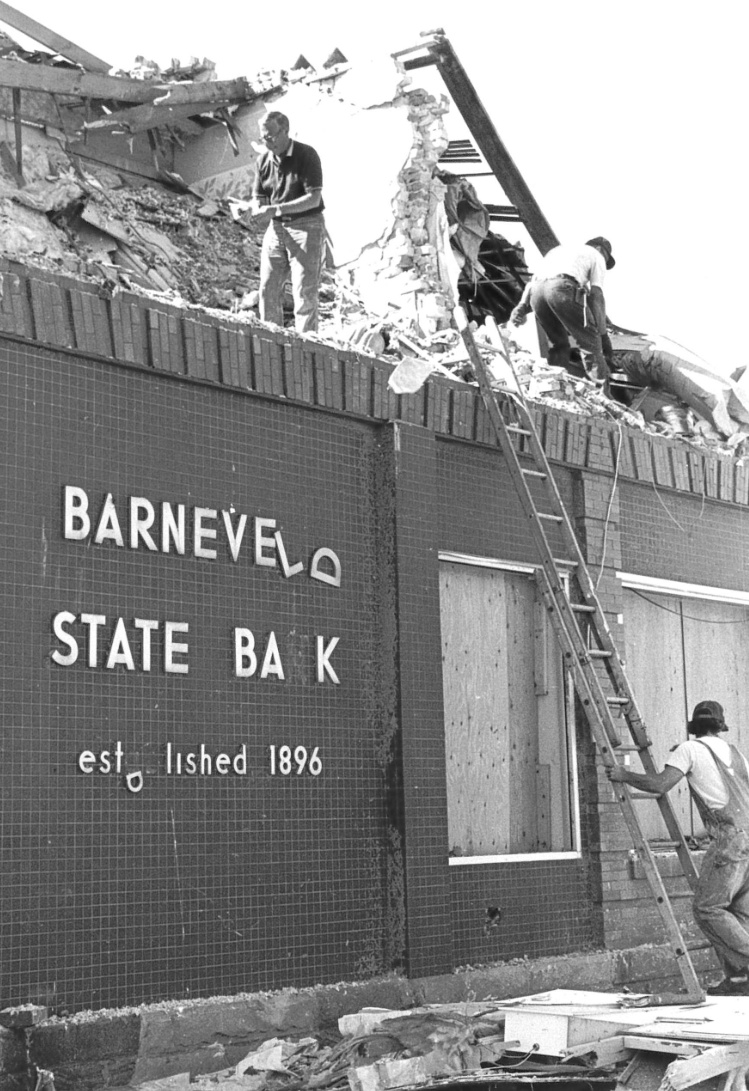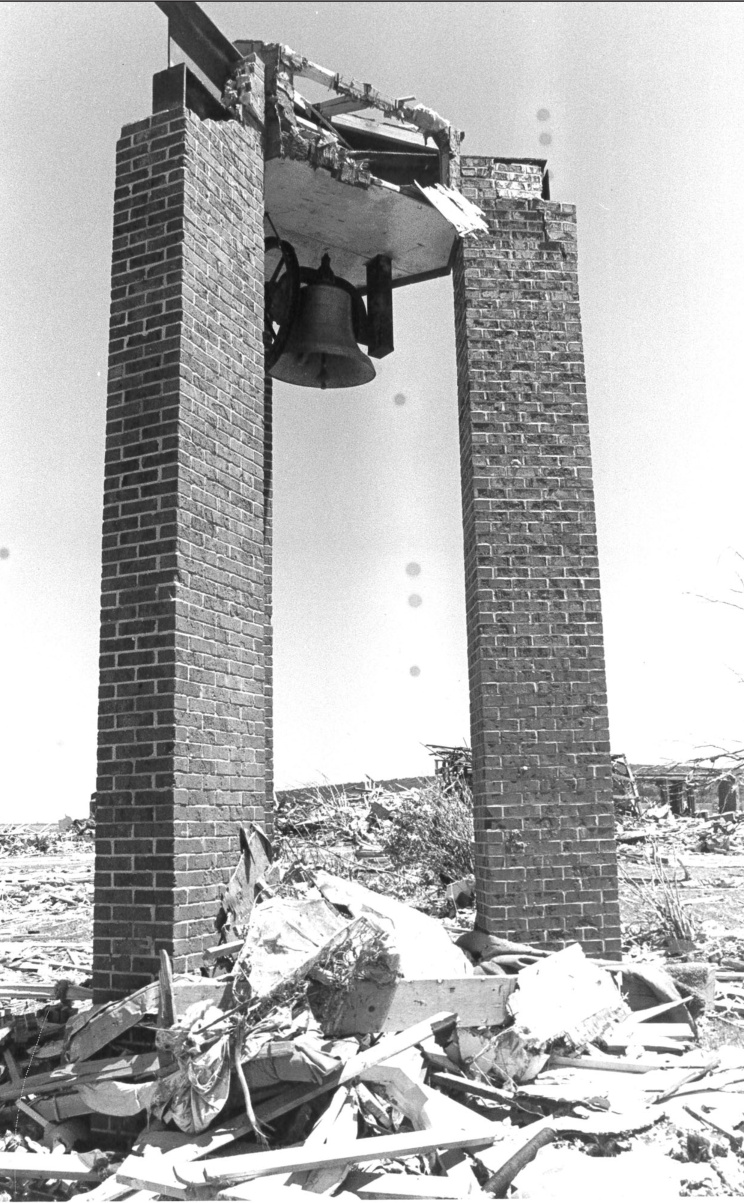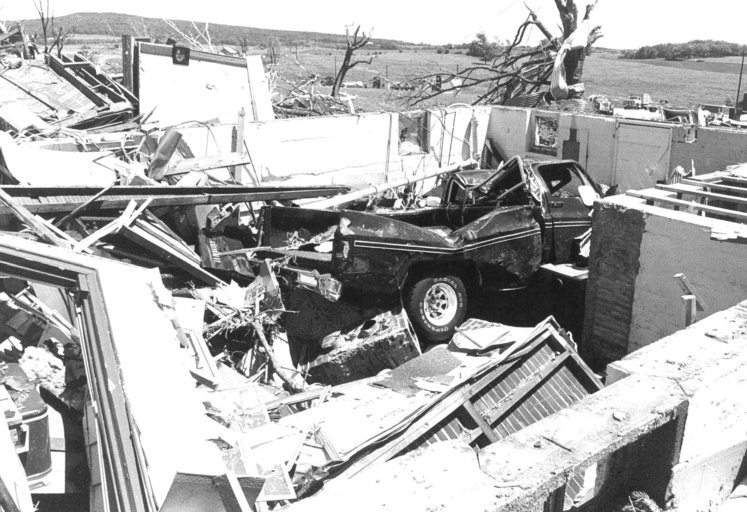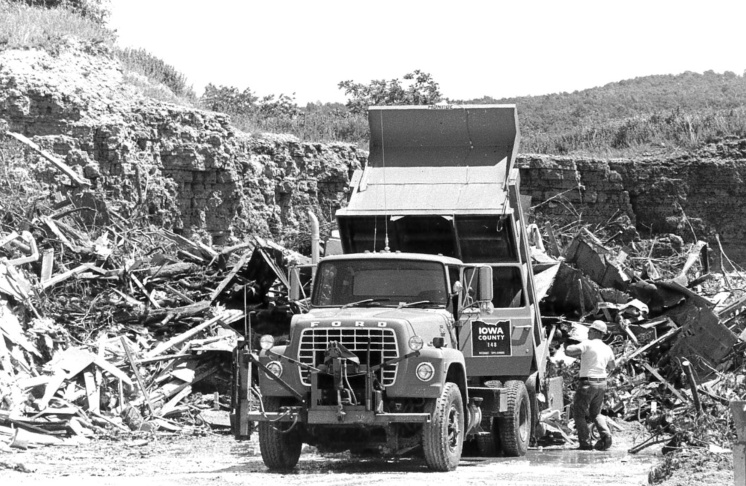

DODGEVILLE – A weather phenomenon known as an “outflow boundary” was key to the infamous Barneveld tornado that took nine lives and virtually wiped the community off the map, a Madison meteorologist said April 11 during a presentation here.
Alex Harrington, a native of Arena in Iowa County and now the chief meteorologist at WISC TV and Fox in Madison, was the guest speaker at the annual spring meeting of the Iowa County Historical Society. He presented research he conducted while in graduate school 20 years ago.
Harrington said the tornado swept through the village at 70 miles per hour with a wind speed of 315 miles per hour. The tornado took just 30 seconds to storm through town, taking with it debris that fell far to the east of Barneveld hours later.
He said it was the strongest tornado in the U.S. in the decade of the 1980s.
Harrington described an outflow boundary as a cold pool of air left over from an earlier shower or thunderstorm. The weather phenomenon can travel more than 100 miles as a rotating tube of air and persist for more than 24 hours to help trigger new thunderstorm development. Any thunderstorm that forms near an outflow boundary has a potential for rotation, Harrington said, and that was the case when a warm front met the outflow boundary during the afternoon and evening of June 7 and early hours of June 8 in 1984.
The severe thunderstorm activity started about 3 p.m. on June 7 in Topeka, Kan., Harrington said, and traveled through Iowa before touching down in Wisconsin. He said it was a “long super-cell journey” for the powerful storm.
Scientists didn’t know about the outflow boundary effect in 1984, Harrington said, so the warning system wasn’t quite as robust. The fact that the tornado hit Barneveld in the middle of the night and the speed of the storm as it raced through the village also made preparations more difficult.
“It was an unbelievable setup for an unbelievable tornado,” Harrington said.
Some of the lowlights of the Barneveld tornado were used by Warner Brothers in the popular 1996 movie “Twister,” he said. Farm implements flying through the air were seen in the movie, similar to what happened in Barneveld when combines and tractors flew from Barneveld Implement in the heart of the village, and buildings were swept away in the movie similar to what occurred on farms just west of Barneveld.
The F5 tornado was one of six F5 tornadoes that have been recorded in Wisconsin history, Harrington said. The storm destroyed about 90 percent of the buildings in the village. An F5 storm occurs in Wisconsin on average about every 25 years.
The Barneveld tornado was different than some F5 tornadoes that move slower and can do even more damage. Harrington gave an example of a tornado that hit Jarrell, Texas, in 1997, with an estimated
wind speed of 318 miles per hour. The difference was that the Texas storm sat stationary over Jarrell for nearly five minutes, “pulverizing” everything in its sight, while the Barneveld tornado had similar internal wind speeds but moved faster and simply swept things away.
Harrington said the wind speed of a tornado is determined based on the type of damage it inflicts.
“What I know about Barneveld give me a profoundly different appreciation for tornadoes,” Harrington said.
Several people at the presentation had vivid recollections of the aftermath of the tornado, from stories about victims by the dozen who were brought to the then Memorial Hospital of Iowa County (now Upland Hills), to emergency medical technicians who remembered the severity of injuries they encountered, and the “eerie quiet” that settled on the village just moments after the tornado was gone.
Dr. Paul Biere said he spent 36 hours in the operating room treating people after the storm.
“When you see people coming in with horrible injuries like that, you know there are another 50 or 70 coming behind them,” he said. “These are the kinds of things that you remember your whole life.”
After the storm left Barneveld, it deposited remnants of the community on a line that went northeast to Black Earth and on to Columbia County until about 3 in the morning.
Weather forecasters didn’t have the same sophisticated meteorological tools in 1984 as are available today, Harrington said, so the warnings for the Barneveld storm weren’t as robust as they are today.
“Today if conditions were the same as they were for that storm, we would have wall-to-wall coverage on television to warn people of what might be coming,” he said. “It doesn’t matter the time of day, we’ll be on TV to warn people.”
The Barneveld storm taught people that morning thunderstorms often have an impact on severe weather later in the day.
“Nighttime tornadoes are incredibly dangerous, because people can’t see them coming,” Harrington said. “Many people in Barneveld said a sharp bolt of lightning and rolling thunder were their only warning before the storm hit.”
Harrington invited people who have further recollections about the storm to send them to him at aharrington@wisctv.com, and he also welcomed feedback on his presentation.