
The Wisconsin Department of Health Services (DHS) measles data dashboard has been updated today, Friday 9/4/26 with the total number of confirmed cases in Iowa County at 62. Total cases in this SW WI regional outbreak (Iowa, Grant and Lafayette Counties) have increased to 136 confirmed and 6 probable cases. Grant County has 15 confirmed cases; Lafayette County has 59 confirmed, 6 probable cases. To protect individual privacy, no additional personal identifying or health information will be released by DHS. Measles case count dashboard at https://www.dhs.wisconsin.gov/immunization/measles.htm
Additional cases in Iowa County since Tuesday equals 7. This increase in cases reflects ongoing transmission among people connected to previously identified cases. Measles is a very contagious virus, and any exposure can be consequential. When one person has measles, 9 out of 10 people they come in contact with will also get measles if they are not protected. It can take up to 21 days for someone to develop measles symptoms after they are exposed. Due to these factors, we expect to see additional cases among close contacts. Symptoms begin with a fever, cough, runny nose, and red eyes. A rash appears several days later that starts at the head and spreads down the body. Anyone who develops symptoms of measles should stay home and call their health care provider prior to seeking care. Calling ahead gives facilities time to take precautions to protect staff and other patients.
Iowa County Health Department continues to work with DHS to identify cases and potential exposures, making sure people who have been exposed receive appropriate guidance, offering testing and vaccination.
Our recommendation to the public remains a message of prevention!
- Check your vaccination status and know if you are protected against measles. Wisconsin residents can check their vaccination status online using the Wisconsin Immunization Registry https://www.dhfswir.org/PR/logoff.do Questions re your vaccine status or access to vaccine should begin with a call to your health care provider.
- If you are not vaccinated, make a plan to get an MMR vaccine.
- The MMR vaccine provides excellent protection against measles. The MMR vaccine is safe and has been used for over 50 years.
- The MMR vaccine is available at area doctor’s offices or clinics, local health departments, and some pharmacies. People who do not have health insurance, or whose insurance may not cover vaccines may be able to get help from the Vaccines for Children and Vaccines for Adults programs.
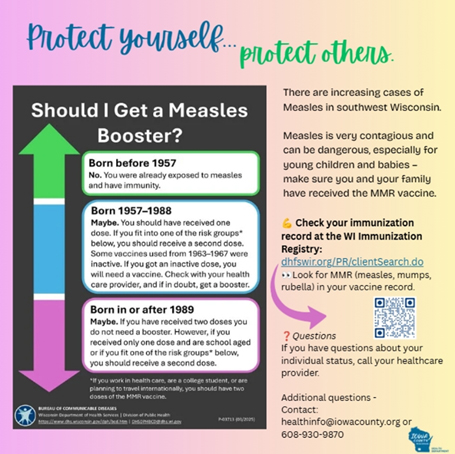
- DHS recommends all children receive two doses of the MMR vaccine by age 4. Those who were born before 1957 are considered immune to measles.
- Find more information about who should get a measles vaccine on the DHS measles webpage and the guide below.