Across rural America, EMS, fire, and rescue departments are struggling with volunteer shortages, making it harder for local communities to staff enough personnel for every shift.
Iowa County is facing the same challenge. This story focuses on EMS, though many of the same issues also affect fire and rescue services. Its goal is to inform county residents about the local situation and encourage more people to consider volunteering with their community ambulance service.
April was EMS volunteer recruiting month. You may have seen billboards in April asking for your time to volunteer. In reality, every month is recruitment month. “We’ve been advertising for a long time and trying to get volunteers to have a commitment to come see what it is about,” said Dodgeville EMS Chief Brian Cushman, who has been involved with the Dodgeville EMS for 33 years. “We have a no commitment threshold for two months if you want to ride along and decide yep, this is for me or, no its not for me, there’s no hard feelings, it’s basically getting you a taste of what it’s like to help another person in the community.”
Much of the problem comes down to the economy and the demands of daily life. Many young adults are working two jobs to make ends meet, while others are raising children and juggling busy schedules. In my interviews with volunteers and EMS chiefs, many people said they would like to help but feel they cannot commit the necessary time.
Asked when rural EMS started seeing shortage and scheduling issues, Cushman said, “I think it has always been that way. But I would say before Covid, I would say 2018/2019 was about when the shortages we started to see. During Covid, we had an influx of people coming in. And now we’re just starting to see a lot of people dwindling out at the five-year mark. They have other commitments that they want to take care of in their life. They’ve dedicated the five-year mark and they’re moving on. That’s essentially what we’re trying to do is fill the gaps, so that we don’t have a mass exit at the mark. We’re trying to condition them to make sure that they continue with this whole process. Five years is the national average of the burnout of an EMT or provider,” Cushman said.
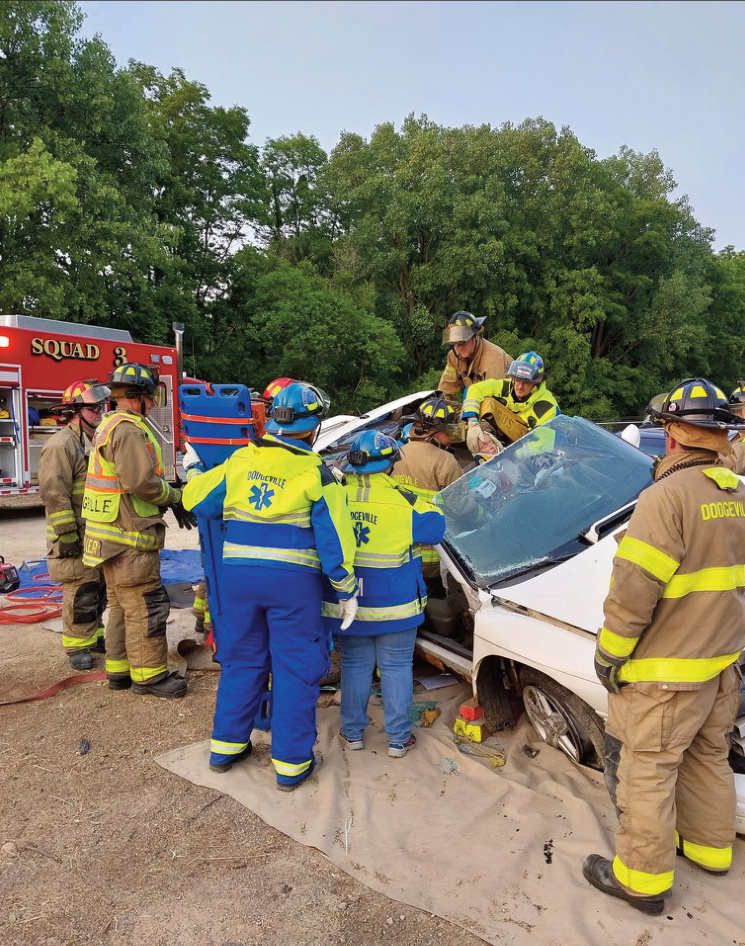
Volunteers can serve in several EMS roles, and grants from the State of Wisconsin help cover the cost of training and education. One entrylevel role is Driver, which requires completion of a driver’s course. The next level is EMR (Emergency Medical Responder), now called EMT One in Wisconsin. An EMT One can count as a provider in the ambulance but cannot be left alone in the back with a patient. They are trained in basic lifesaving skills such as CPR, bleeding control, and rescue breathing until more advanced care arrives. EMT Two (Emergency Medical Technician) is the level at which a responder has the certifications needed to serve as the sole provider in the back of an ambulance. EMTs are trained to assess and manage patients in both routine and critical emergencies. They provide essential care such as controlling bleeding, stabilizing fractures, treating signs of shock, and safely transporting patients to medical facilities.
In addition to EMT-level responsibilities, AEMTs (Advanced Emergency Medical Technicians) can administer certain fluids and medications to help stabilize patients in more complex situations. They are also trained to use advanced equipment, including airway devices and cardiac monitors, to provide a higher level of care during emergencies and patient transport.
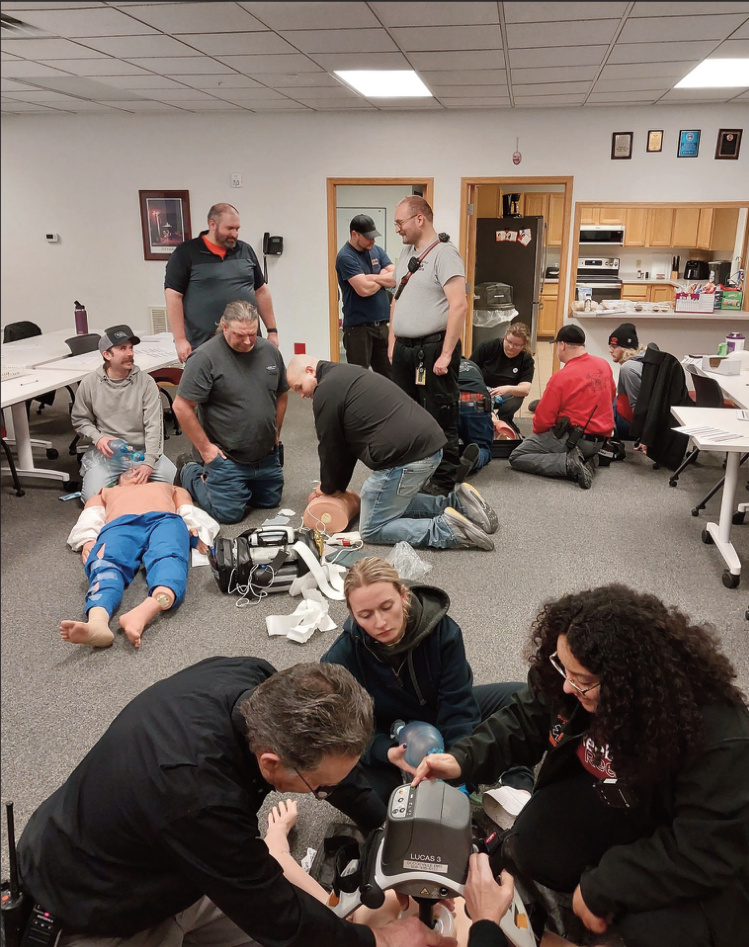
Each certification level requires training and instruction. Coursework can be completed through a combination of online learning, local classes at EMS stations, and courses at Southwest Tech.
Montfort EMS Chief Pete Hoffman has been volunteering in Montfort for thirty years. “I started out as a driver, and then I took the courses and became an EMT. So, I’ve been an EMT now since 2006. Southwest Tech has been very, very instrumental in a lot of departments here covering the five counties that they cover,” he said. In many of our local communities, volunteers have put in years of service but they’re getting older.
“I started looking at the age of our department. We have a really good department. I’m very proud of my members here, but we’re aging. The average age of our members is 50 plus years, so we’re going to age out,” said Hoffman.
Kimberly Cleary has been involved with EMS since 2016 both in Highland and Dodgeville. When asked why she got involved she said, “Honestly, I thought anyone who was in EMS was kind of crazy. It was not something I ever wanted to do. I was super excited when my CPR card expired because I didn’t want to be that person. And then the Paris attacks happened (December of 2015). And I was thinking if something like that happened here, could I help, what could I do. I didn’t have any skills at that time, learning skills to help others in an emergency situation. So, I called up my sister-in-law who is in EMS, and I contacted Neil Michek (Highland EMS Chief), and he said classes start next week, so I took a leap of faith and here I am,” she said.
To be clear, volunteers do receive a stipend for calls in some locations. Some EMT’s and AEMT’s are paid on a part-time and full-time basis. In Dodgeville, Cushman said, “Essentially, we do offer a stipend when they come in the door. We’re giving you an incentive to come into the door and make sure that your time is worth something to the community as what we’re looking at.”
Cleary still lives in Highland but works full-time in Dodgeville. “I ended up here because I worked with Chief Cushman at Lands’ End. LE has a great first responder program and they allow you to leave during work hours to respond to emergencies in the city, so once he found out I was in EMS classes he convinced me to work here, I joined in the fall of 2016, along with another classmate of mine, who also worked in town. I volunteered here (Dodgeville) and Highland until 2021 until they started hiring full-time,” she said.
She thinks part of the reason there is an EMS shortage is people don’t know a lot about it. “I think people think EMS is these screaming lights and siren trauma situations that’s more like a horror movie which I think deters a lot of people. There’s a lot of training and lot of responsibility and stuff we have to keep up with. But people are busier now with kiddos and working more jobs to make ends meet.”
Michael Gorman has been an EMS volunteer in Dodgeville for five years and has over 38 years of experience in EMS and as a law enforcement officer as the Village Marshal in Ridgeway. Over the years the satisfaction of helping someone on their worst day has been very gratifying. “When you’re out in the community and somebody comes up to you and says hey, I remember you when I needed help and I just want to say thanks,” he said. “A large part of it is just bedside manners, we’re a very dedicated, very compassionate group of individuals. That’s the culture we’ve built here in Dodgeville, part of our Hallmark is our patient care,” he said.
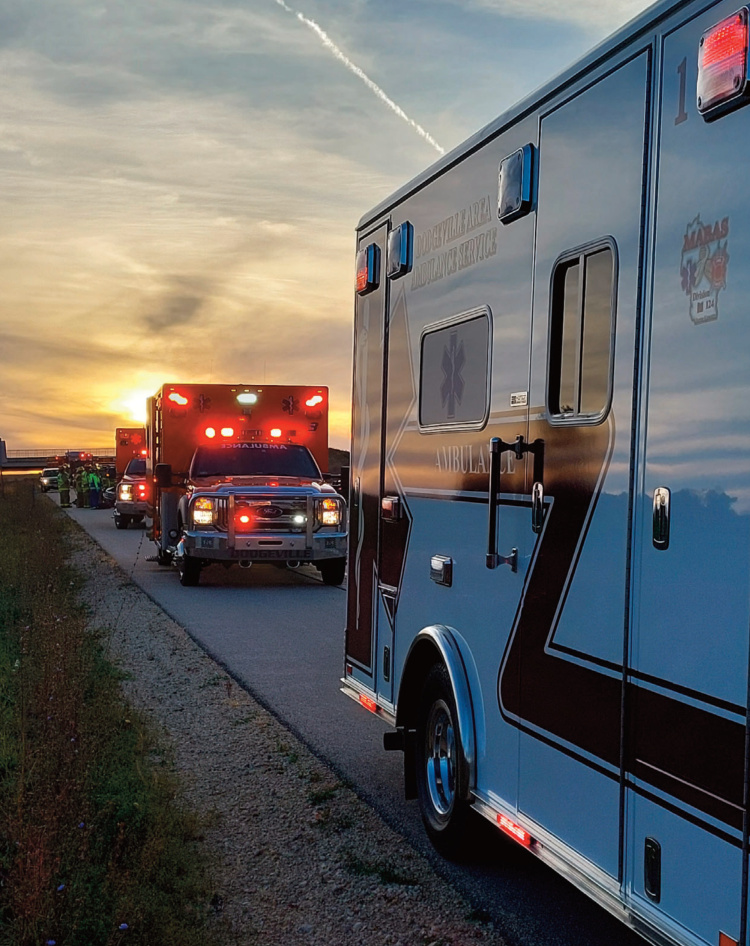
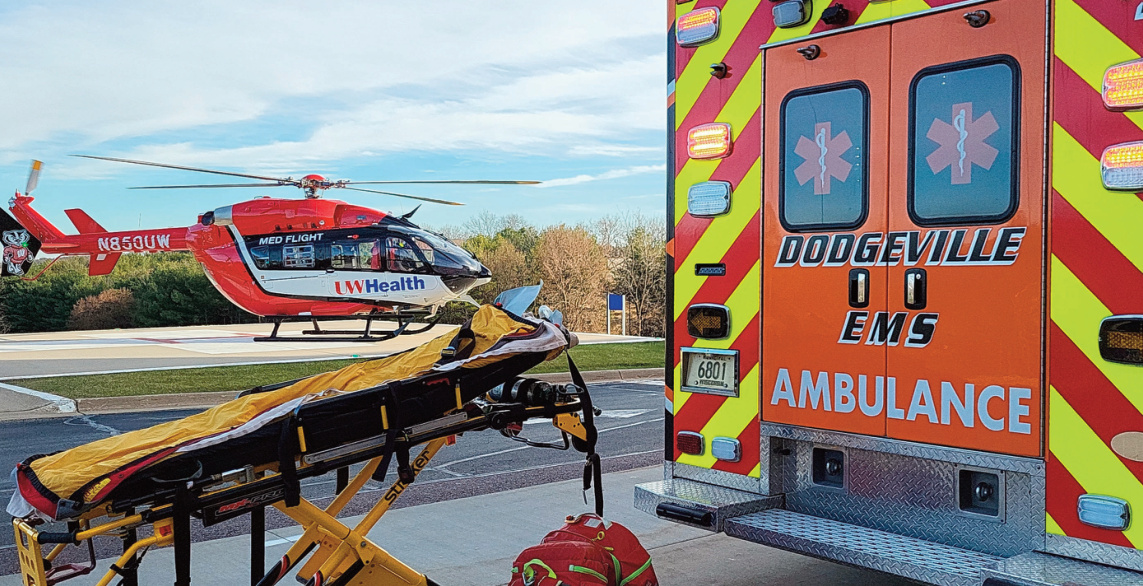
Mutual aid is vital in Iowa County for EMS to assist other communities, as well. Many of these smaller villages and townships cover over 75 square miles and to get to the person in need can take time with the terrain and winding roads the county has. Scheduling volunteers with paid staff can be complex, and the schedule, at a minimum is two months planned in advance.
“It doesn’t matter if you’re from Dodgeville, Barneveld, Highland, or Montfort, or down through Hazel Green, we are all EMS at one point in time, we’ll need help from other communities because there is not enough staff,” said Gorman. “Even something as simple as driving the ambulance itself is a big deal.”
Krista Thompson, EMS Chief in Barneveld feels the volunteer pinch in her department but also feels she has a good staff, thanks to bringing on some paid staff in 2023 to help with volunteer gaps. “We certainly feel the shortage. We lost some members for a while, and we did fortunately have some members come back. There’s always a shortage it seems like, even during the day, a lot of times we really struggle with having enough staff to cover the days because a lot of people work out of town and have other job commitments,” she said.
“So, in 2023 we did bring on some paid staff to help with those gaps, to make sure we’re having good response times and being able to still provide care to the community,” said Thompson. The National average response time for a rural ambulance is approximately eight minutes. Every EMS Chief in Iowa County was proud to say they had a crew gathered and went out the door in less than five minutes once a call came in.
“That’s pretty impressive when you think about it. The national average is eight minutes to get an ambulance rolling. So, we’ve already cut that in half with the great crews that we have here in Iowa County,” said Cushman.
Because his father was one of the founding members of the Highland EMS and was an EMT for over 50 years, his influence on current Highland EMS Chief Neil Michek is why he has been an EMT for 34 years. “Fortunately, here in Highland, we’ve got a really great support system from the community. But like anywhere, just like a job, people tend to age out eventually,” Michek said.
“If you look at the history of Highland EMS, most people hang around for somewhere between 10 to 15 years before saying enough is enough. So yeah, we need to constantly find new people,” said Michek. “It’s a problem in rural America. The biggest challenge is probably the initial training time. I mean, a lot of people want to help. A lot of people are a little bit nervous about whether they can handle the stresses of it. But if we allow some people to ride along once in a while to get an idea of whether they like it or not, that may help a little bit.”
Highland currently has roughly 30 volunteers, none of which are parttime or full-time employees. He said the payroll at Highland for 54 years is a perfect zero. “Everyone is purely volunteer, our call volume doesn’t justify it, yet. We’ve been lucky enough to have enough people to cover during the day,” he said. He said weekend coverage is better because people are home Friday night from their job for the weekend.
His message to those thinking of being an EMS volunteer? “It is very rewarding. The feedback you get from that patient, helping them in a small community. You need EMS and somebody has to step up and do the job. It’s not as scary as it looks on TV. It’s not the blood and guts you see on Chicago Fire or 911. Yeah, there can be some exciting and weird situations, but mostly it’s taking care of your neighbors, its very rewarding,”
In Montfort, no one is paid either. “We’re all volunteers,” said Hoffman. “We do offer a small hourly stipend for the shift times they pick up.”
Ryan Currie has been a volunteer at Dodgeville for fifteen years and when asked what keeps him active in EMS, “The community. I love being here and able to help people. I love being able to drive down a street and occasionally see someone I helped out. I have also been a patient in the back of the ambulance, once for a kidney stone and recently a major leg injury when a 300-point weight fell on my leg rupturing my ACL. Those are reminders to me of how much we need EMT’s and why I won’t give this up,” he said.
Because he was already trained as an EMT, he was able to go through a checklist on his own assessing his injury waiting for an ambulance to arrive. “Reassessing myself is what kept me calm during the whole situation and allowed me to help EMT’s when they arrived. The ambulance crew was absolutely fantastic. I can’t get over how incredibly compassionate they all were.”
Currie’s message to anyone considering being a volunteer is, “Just the knowledge you gain with the training, I don’t panic at anything anymore, I know how to assess the situation. You never know when you might come across a car accident and be able to help, or you’re at a restaurant and someone starts choking, or begins to have a hear attack, you can help in those situations. If nothing else, I encourage everyone to at least take a CPR course.”
In Barneveld, Thompson’s message is, “It takes a lot of special people to do this. We’re taking care of people on their worst day and to be able to provide comfort to the patient, we’re there to help them, it’s a great feeling to be able to do that for people,” she said. “Try to get out there and see what you can do because we need people. I personally had a family member my brother was in a serious farming accident, and I actually responded to that call, and it meant the world to me that I was there. Like my friend said, God had you in the right place that day, right where you needed to be.”
“All I can say is its one of the most noblest things that you can do,” said Gorman. “A lot of people here in Southwest Wisconsin as a whole to take care of their community members. And if you want to be part of it, this would be a great opportunity for those people looking for a purpose-driven life. My concern is there’s a crisis looming, and we don’t want to be in a place where an ambulance can’t run.”
In Montfort, Hoffman’s message for those thinking about how they can help their community, “I just encourage anybody that has an inkling about doing it, go to the rescue squad in their community and just talk to them, and I think once they get into it, once they get past I can’t, I can’t, I can’t, they’ll find out they can and they’ll find out its very rewarding and very empowering. This is the avenue. I know that person can help your community, help your neighbor, help the people in the next community over. Join the rescue squad. Join the fire department. Become active in your community.”
“Give it a shot! If you have interest and you can do the time commitment, at least do the initial school to get your foot in the door, just try it, don’t think it’s something you can’t do, because you never know what you can do until you’re in it,” said Cleary. “At the end of the day, it’s about people, whether it’s a bad trauma, or it’s somebody who is throwing up, that’s a person. Your teammates, your people. So, if you have an interest in people and helping people, give it a shot. If you like working as a team, give it a shot. If you’re interested in making a team stronger, and being an active part of doing that, it’d be worth a shot.”
Cushman echoes a similar message. “I think the important message is, don’t be afraid to take that next step. We have plenty of people that are willing to invest time in you and make this commitment, so that the community does need our help to make sure their medical needs are taken care of.”
Iowa County residents, the need for local EMS volunteers is clear. Getting involved can be as simple as making a phone call. Training and schooling are paid for, mentorship is available, and the ride-along program lets you see what EMS work is really like. Your community needs you to step up. As Cleary said, give it a shot.