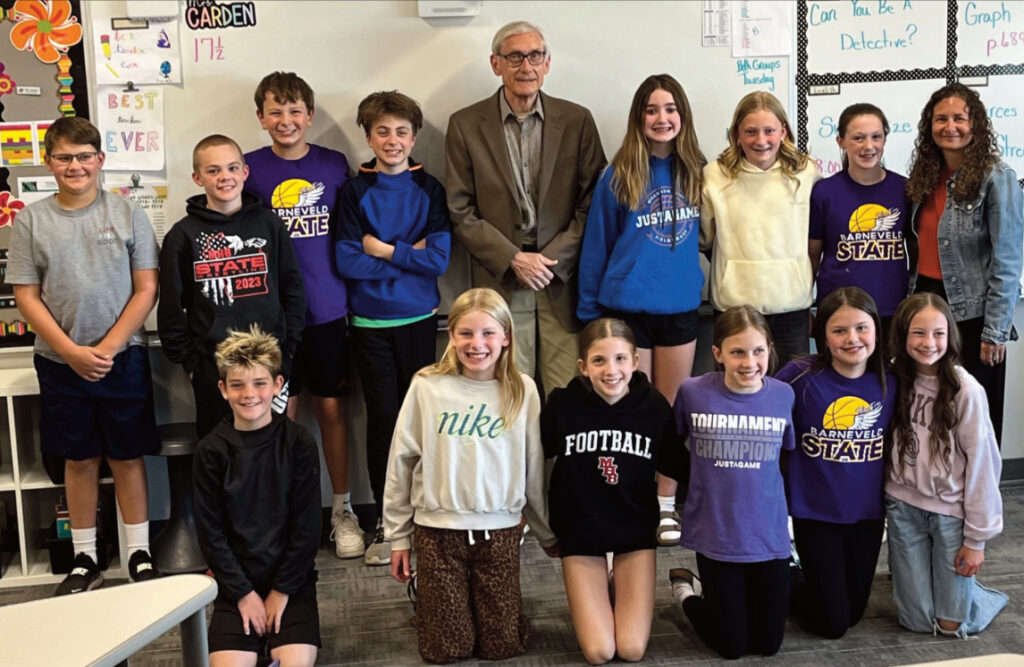
Gov. Tony Evers visited the Barneveld Middle/High School Monday, May 11.to meet with students, educators, and school staff within the Barneveld School District to highlight the governor’s support for Wisconsin’s kids and schools, as a former science teacher, principal, superintendent, and state superintendent.
While visiting, the governor highlighted his efforts to do what’s best for our kids and support our schools, including investing in kids and schools at every level through the bipartisan, pro-kid 2025-27 Biennial Budget.
Additionally, Governor Evers heard about the district’s Sources of Strength program, which is a youth mental health promotion and suicide prevention program that calls on peer social networks to create healthy and supportive environments for students.
Gov. Evers, who began 2025 by declaring it the Year of the Kid in Wisconsin, had been clear from the beginning of the budget process that his top priority in the 2025-27 Biennial Budget was to pass a pro-kid budget that makes meaningful investments in Wisconsin’s kids at every stage and every age, from early childhood to K-12 to our higher education institutions.
While the final 2025-27 Biennial Budget does not include the full and significant investment Gov. Evers initially proposed in his executive budget, the state budget enacted in July last year builds upon the governor’s historic increase in spendable authority for public school districts in the 2023-25 biennium, which included using his partial veto authority to ensure new spendable authority for public school districts would be predictable and substantial.
As a former teacher, principal, superintendent, and state superintendent, Governor Evers fought hard to make sure the 2025-27 Biennial Budget provided increased investments for Wisconsin’s kids and public K-12 schools. After Republican lawmakers threatened to provide no new increases for schools, through negotiations, Gov. Evers secured:
A nearly $1.4 billion increase in spendable revenue for K-12 schools across the state in the 2025-27 Biennial Budget, an over $200 million increase from the historic 2023-25 K-12 budget;
The net categorical aid increase is roughly five times larger than the increase provided in the most recent state Biennial Budget and a nearly 100 percent increase above the amount previously approved for K- 12 schools by Republican lawmakers on the state budget committee.
The largest percent increase in te special education reimbursement rate in state history, which will increase to 42% in the first year of the biennium and 45 percent in the second year of the biennium;
This is the highest reimbursement rate in 30 years and a larger increase for special education than the last three state budgets combined.
This is a more than half-a-billion dollar investment and more than double the increase from the previously approved motion by Republicans on the state budget committee. . Over $54 million over the biennium for high-cost special education aid;
This will increase the reimbursement rate of this program from its current estimated 25.9% to 50%t in fiscal year 2025-26 and 90 percent in fiscal year 2026-27.
$30 million to continue providing comprehensive school-based mental health services statewide, modeled on the governor’s successful “Get Kids Ahead” initiative; and
In 2022, Gov. Evers created the successful “Get Kids Ahead” initiative, designed to help support kids’ mental and behavioral health in schools across Wisconsin, and directed $30 million in federal funding to support the effort to expand access to school-based mental health services.
Gov. Evers previously fought to secure $30 million in state funding as part of a bipartisan compromise on shared revenue during the last biennium to build upon the success of his “Get Kids Ahead” initiative and ensure kids across Wisconsin would continue to have access to comprehensive mental health services in K- 12 schools.
This investment secured by Gov. Evers in bipartisan budget negotiations with Republican leaders continues building upon this important work, ensuring school-based mental health services continue to be available for kids at school through the next two years.
$2 million in operations funding for the DPI in the state budget committee’s Supplemental Fund after Republican lawmakers previously voted to cut 10 percent of the agency’s operating costs in each year of the biennium through the state budget process.